
13 min read
Home Battery Storage Systems for Solar (2026 Guide)
TL;DR:
- Installed costs range from $10,000–$20,000 for a single 10–13.5 kWh unit; the federal 30% ITC reduces net cost to $7,000–$14,000
- Most homes need 10–20 kWh of usable storage for overnight coverage; a 30 kWh/day home requires ~16.7 kWh rated capacity after depth-of-discharge adjustment
- Battery storage ROI improves dramatically in states with time-of-use (TOU) rates, frequent outages, or reduced net metering export credits
- Tesla Powerwall 3 and Enphase IQ Battery 5P lead the 2026 market on efficiency and reliability; LFP chemistry outlasts NMC by 2–3x
What Is a Home Battery Storage System for Solar?
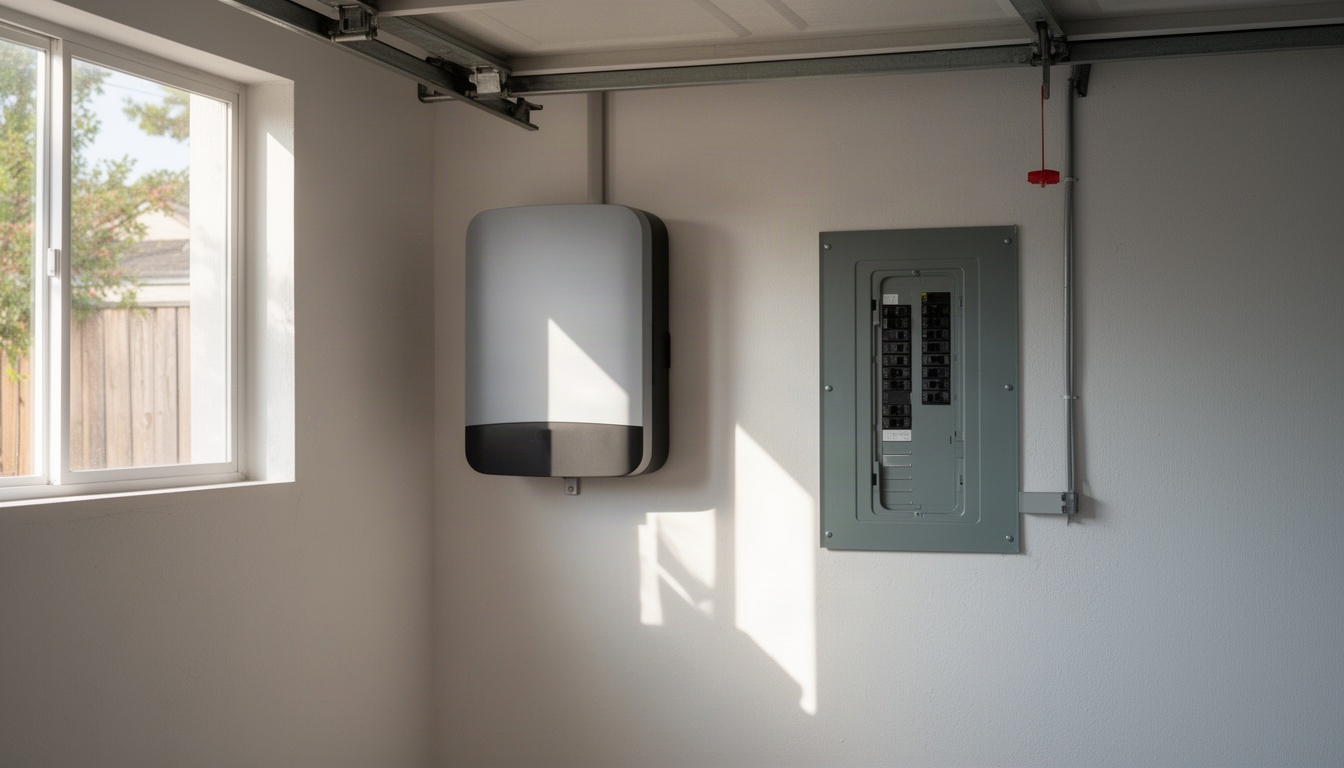
A home battery storage system for solar is a rechargeable battery that stores excess electricity generated by your residential solar panels during the day so you can use it at night, during peak-rate hours, or when the grid goes down.
Here's how it works: your solar panels generate DC electricity → an inverter converts it to AC for your home → excess power charges the battery instead of flowing to the grid → when the sun sets or demand spikes, the battery discharges to power your home.
According to Enphase, lithium-ion products are now the most common solar energy storage systems for homeowners, replacing older lead-acid technology. The three core benefits are straightforward:
- Backup power during outages: Unlike grid-tied solar alone, a battery-backed system keeps your lights on when the grid fails
- Bill reduction through time-of-use arbitrage: Charge your battery at low off-peak rates, discharge during expensive peak hours
- Grid independence: Reduce reliance on utility exports and the declining compensation rates they offer
Most residential systems use lithium iron phosphate (LFP) chemistry, which Enphase confirms is the safest home solar battery technology on the market. LFP batteries tolerate deeper discharge cycles and wider temperature ranges than older nickel-metal-hydride designs.
Key Takeaway: Home battery storage pairs with solar to shift energy use from peak-rate hours to off-peak hours, reducing electricity bills by 20–40% in high-rate states like California.
How Much Do Home Solar Battery Systems Cost in 2026?
Direct answer: A single residential battery system costs $10,000–$20,000 installed before incentives. After the federal 30% Investment Tax Credit, net cost drops to roughly $7,000–$14,000.
Here's the cost breakdown for a typical 13.5 kWh system:
| Cost Component | Typical Range |
|---|---|
| Battery hardware (13.5 kWh) | $4,500–$6,500 |
| Inverter/BMS | $2,000–$3,000 |
| Installation labor | $2,500–$4,000 |
| Permitting & interconnection | $500–$2,500 |
| Total installed cost | $10,000–$20,000 |
According to EnergySage, solar batteries typically cost about $15,650 before incentives for the 13.5 kWh of storage a typical home needs. Equipment costs account for 50–60% of the total price; labor represents the remainder.
Federal incentive math: A $15,650 system × 30% ITC = $4,695 tax credit → net cost of $10,955. File this on IRS Form 5695 when you file taxes.
Per-kWh comparison across top models (2026 installed pricing):
| Model | Usable Capacity | Installed Cost | Cost/kWh |
|---|---|---|---|
| Tesla Powerwall 3 | 13.5 kWh | $14,500–$17,000 | $1,074–$1,259/kWh |
| Enphase IQ Battery 5P (3 units) | 15 kWh | $13,500–$16,000 | $900–$1,067/kWh |
| LG RESU Prime 16H | 16 kWh | $15,000–$18,000 | $938–$1,125/kWh |
| Franklin Electric aCorner | 13.6 kWh | $12,500–$15,000 | $919–$1,103/kWh |
Real payback example: Assume a $13,500 installed Powerwall 3 system in California with $1,200 annual savings from TOU arbitrage:
- Simple payback (pre-incentive): $13,500 ÷ $1,200 = 11.25 years
- Net cost after 30% ITC: $13,500 − $4,050 = $9,450
- Adjusted payback: $9,450 ÷ $1,200 = 7.9 years
Add state rebates (California SGIP pays up to $200/kWh) and payback shrinks further. California's SGIP program provides rebates up to $150–$200 per kilowatt-hour for qualifying residential battery storage, with enhanced incentives for low-income and high fire-risk households.
Key Takeaway: A $13,500 battery system costs $9,450 net after the 30% federal tax credit. At $1,200/year in savings, payback is 7.9 years – well within the 10–15 year warranty period.
Top Home Battery Storage Systems Compared (2026)
Choosing between battery models requires comparing usable capacity, power output, efficiency, warranty, and price. Here's how the market leaders stack up:
| Model | Usable Capacity | Continuous Power | Round-Trip Efficiency | Warranty | Best For |
|---|---|---|---|---|---|
| Tesla Powerwall 3 | 13.5 kWh | 11.5 kW | 97.5% | 10 years / 70% | Whole-home backup; high power output |
| Enphase IQ Battery 5P (3 units) | 15 kWh | 11.5 kW | 96% | 15 years | Modular scaling; longest warranty |
| LG RESU Prime 16H | 16 kWh | 7 kW | 95% | 10 years | Largest single capacity; NMC chemistry |
| Franklin Electric aCorner | 13.6 kWh | 10 kW | 96% | 10 years | LFP chemistry; competitive pricing |
| Sonnen ecoLinx | 10–20 kWh | 8 kW | 86% | 10 years | Smart grid integration; VPP-ready |
What each excels at:
Tesla Powerwall 3 delivers the highest continuous power (11.5 kW) and industry-leading round-trip efficiency. It integrates a solar inverter, reducing hardware complexity for new installations. Best for homeowners wanting whole-home backup and willing to pay a premium for brand recognition.
Enphase IQ Battery 5P uses modular 5 kWh units that stack up to 15+ kWh. The 15-year warranty is the longest in the residential market. Best for homeowners who may expand storage later or want maximum warranty protection.
LG RESU Prime 16H offers the largest single-unit capacity (16 kWh) at competitive pricing. Uses NMC chemistry, which has higher energy density but shorter cycle life than LFP. Best for homeowners prioritizing capacity over longevity.
Franklin Electric aCorner uses LFP chemistry (safer, longer-lived) with 13.6 kWh capacity and 10 kW power output. Priced 10–15% below Powerwall 3. Best for cost-conscious buyers who prioritize chemistry durability over brand name.
Sonnen ecoLinx emphasizes smart energy management and grid services. Lower round-trip efficiency is offset by premium VPP integration. Best for homeowners in utility territories with active virtual power plant programs.
Critical spec to understand: Round-trip efficiency measures total losses during charge and discharge cycles. According to S3-C5, round trip efficiency accounts for charging losses, inverter conversion losses, and discharging losses. Over 10 years of daily cycling, efficiency differences compound to meaningful bill differences.
Key Takeaway: Tesla Powerwall 3 leads on power output and efficiency; Enphase IQ Battery 5P offers the longest warranty (15 years) and modular scaling; Franklin aCorner provides LFP chemistry at lower cost.
How Do You Size a Solar Battery Storage System?
Direct answer: Most homes need 10–20 kWh of usable storage to cover overnight loads or a 24-hour outage. A home consuming 30 kWh per day requires approximately 16.7 kWh of rated capacity after adjusting for depth of discharge.
Here's the step-by-step sizing walkthrough:
Step 1: Calculate your daily electricity consumption. Check your utility bill for average daily kWh. If your bill shows 900 kWh/month, divide by 30 days = 30 kWh/day.
Step 2: Estimate overnight load. Overnight loads (roughly 6pm–6am) typically represent 40–50% of daily consumption. For a 30 kWh/day home:
- Overnight load = 30 kWh × 0.50 = 15 kWh
Step 3: Adjust for depth of discharge (DoD). Most lithium batteries are rated for 80–90% depth of discharge. This means you can only draw 80–90% of rated capacity before the battery management system stops discharge to protect longevity. According to Sunwatts, if you need 10 kWh per day and the battery has 80% DoD, then you should look for a 12 kWh battery.
For our 15 kWh overnight need at 90% DoD:
- Required rated capacity = 15 kWh ÷ 0.90 = 16.7 kWh
Step 4: Choose between critical-loads-only or whole-home backup.
Critical loads only (refrigerator, lights, internet, medical equipment): typically 3–5 kWh/day → 4–7 kWh battery Whole-home backup (includes HVAC, water heater, EV charger): 15–30 kWh/day → 18–35 kWh battery
A central AC unit draws 3,500–5,000W during operation. According to the U.S. Department of Energy, a 3-ton air conditioner draws approximately 3,500 watts during operation with surge currents up to 5,000 watts at startup. This single load can exhaust a 10 kWh battery in under 3 hours, making whole-home backup dramatically more expensive than critical-loads-only.
Appliance power draw reference:
| Appliance | Wattage | Daily Runtime (hours) | Daily kWh |
|---|---|---|---|
| Refrigerator | 150W | 8 | 1.2 kWh |
| LED lights (whole home) | 200W | 4 | 0.8 kWh |
| Internet/WiFi | 50W | 24 | 1.2 kWh |
| Central AC | 3,500W | 4 | 14 kWh |
| Electric water heater | 4,500W | 2 | 9 kWh |
| EV charger (Level 2) | 7,200W | 2 | 14.4 kWh |
Step 5: Account for climate and seasonal variation. According to Sunwatts, in cold winter climates, battery over-sizing can range from 10% to 40%. Cold temperatures reduce battery efficiency and usable capacity. If you live in Minnesota or upstate New York, add 20–30% to your calculated capacity.
Key Takeaway: A 30 kWh/day home needs ~16.7 kWh rated battery capacity for overnight coverage. Whole-home backup (including AC) requires 25–35 kWh; critical-loads-only requires 5–10 kWh.
What Solar Battery Incentives and Rebates Are Available?
Direct answer: The federal Investment Tax Credit covers 30% of battery storage cost when charged primarily by solar. State rebates, utility VPP programs, and tax exemptions can stack to reduce net cost by 50–70%.
Federal incentive: 30% ITC
The IRS Residential Clean Energy Credit allows you to claim 30% of battery storage installation costs on your federal tax return. The credit applies to systems installed from 2022 through 2032. File on IRS Form 5695 when you file taxes.
Example: $13,500 system × 30% = $4,050 tax credit (claimed on your 2026 tax return).
State-level rebates:
California: SGIP provides rebates up to $150–$200/kWh for qualifying residential battery storage. Equity and resiliency adders can bring total incentives above $1,000/kWh for eligible low-income and high fire-risk customers. A 13.5 kWh system could qualify for rebates in the range of several thousand dollars.
Florida: No state income tax and no dedicated battery rebate program, but net metering rules allow solar export credits at retail rates. Battery storage is less financially critical in Florida than in states with reduced export compensation.
Texas: No state income tax and no battery rebate. However, DSIRE lists numerous policies and incentives for renewables and efficiency across Texas, including some utility-specific programs. Check with your local utility (Austin Energy, Oncor, etc.) for battery incentives.
Utility virtual power plant (VPP) programs:
Utilities increasingly pay homeowners to dispatch stored battery energy during peak demand periods. Tesla's Virtual Power Plant program pays enrolled Powerwall customers $50–$300 annually for allowing Tesla to discharge their battery during grid stress events. Green Mountain Power in Vermont offers one of the most generous programs: $1,600 upfront incentive plus ongoing grid service credits.
Incentive stacking example (California):
- System cost: $13,500
- Federal 30% ITC: −$4,050
- SGIP rebate (13.5 kWh × $200): −$2,700
- Net cost: $6,750 (50% reduction)
Tax exemptions:
According to DSIRE, several states exempt battery storage from sales tax or property tax. California exempts solar and storage equipment from sales tax. This saves an additional 7–10% on hardware costs.
Key Takeaway: Stack the 30% federal ITC + state rebates + utility VPP programs to reduce net battery cost by 50–70%. California homeowners can achieve net costs under $7,000 for a 13.5 kWh system.
Is a Home Solar Battery Worth It for Your Home?
Direct answer: Battery storage is worth it for most homeowners in states with time-of-use (TOU) rates, frequent grid outages, or low net metering export rates. Payback periods of 7–10 years are now common with incentives factored in.
Four scenarios where batteries make clear financial sense:
1. Time-of-use (TOU) rate arbitrage If your utility charges $0.10/kWh during off-peak hours (11pm–6am) and $0.40/kWh during peak hours (4pm–9pm), a battery can charge cheap and discharge expensive. According to Lawrence Berkeley National Laboratory, time-of-use rate optimization can generate meaningful savings per cycle. On a 10 kWh daily cycle, this can translate to approximately $3/day or ~$1,095/year in gross savings.
2. No export compensation (NEM 3.0 states) California's NEM 3.0 (effective April 2023) significantly reduced solar export compensation. In this environment, storing excess solar for self-consumption is far more valuable than exporting to the grid. Battery ROI improves dramatically.
3. Frequent grid outages If your area experiences more than 2 outages per year, backup power has tangible value beyond bill savings. The peace of mind and avoided spoilage/data loss justify battery cost.
4. Off-grid or grid-independent goals If you want to minimize grid dependence or live in a remote area with unreliable utility service, battery storage is essential, not optional.
Two scenarios where payback is harder:
1. Generous full-retail net metering If your utility pays retail rates for all solar exports (rare post-2023), exporting excess solar to the grid is nearly as valuable as self-consuming it. Battery ROI is marginal.
2. Very low electricity rates In states like Louisiana or Oklahoma with low average rates, the absolute dollar savings from TOU arbitrage are small. Payback extends beyond 12 years.
Simple rule of thumb: If your utility pays less than 50% of retail rate for solar exports OR you experience more than 2 outages per year, battery ROI improves significantly. Check your utility's net metering policy and outage history before deciding.
Key Takeaway: Battery storage ROI is strongest in high-rate states (CA, HI, MA), TOU-rate territories, and areas with frequent outages. Payback is typically 7–10 years with incentives.
Finding a Qualified Solar Battery Installer
When you're ready to move forward, reviewing our guide to switching to solar power and finding a qualified installer is as important as choosing the right battery model. Look for installers who are licensed, insured, and experienced with your specific battery chemistry and inverter type.
Green Living Guy provides guidance on sustainable energy solutions and can help connect you with vetted local installers in key markets including California, Florida, Texas, New York, and Nevada. They specialize in helping homeowners navigate the solar-plus-storage decision and understand local incentive programs specific to your region.
Key installer qualifications to verify:
- Licensed and insured in your state (electrician's license + liability insurance)
- Certified by battery manufacturer (Tesla, Enphase, LG, Franklin, etc.)
- Familiar with local permitting and utility interconnection requirements
- Transparent pricing with itemized cost breakdowns
- Warranty support (many installers handle warranty claims on your behalf)
When you get quotes, ask installers to specify usable capacity, round-trip efficiency, and depth of discharge for the system they recommend. Request references from recent installations in your area. A qualified installer should be able to explain why they're recommending a specific battery model for your home's load profile and local utility rates.
Frequently Asked Questions About Solar Battery Storage
How much does a home solar battery system cost installed in 2026?
Direct Answer: A single residential battery system costs $10,000–$20,000 installed before incentives. After the federal 30% Investment Tax Credit, net cost is typically $7,000–$14,000.
According to EnergySage, solar batteries typically cost about $15,650 before incentives for the 13.5 kWh of storage a typical home needs. Equipment costs account for 50–60% of the total price; installation labor represents the remainder. Regional variation is significant – California and New York have higher labor costs than rural areas.
Which home battery storage system lasts the longest?
Direct Answer: Enphase IQ Battery 5P offers the longest warranty at 15 years. LFP chemistry (used in Powerwall 3, Franklin aCorner, and Enphase) outlasts NMC chemistry by 2–3x under typical cycling conditions.
According to NREL research, LFP cells typically deliver 3,000 to 6,000 full cycles before reaching 80% capacity, compared to 1,500–2,000 cycles for NMC chemistry under similar conditions. At one cycle per day, LFP batteries last 8–16 years; NMC lasts 4–5 years. Enphase confirms their IQ Batteries have an industry-leading 15-year warranty.
Can a solar battery run my whole house during a power outage?
Direct Answer: Yes, but only if sized for whole-home loads. A typical 13.5 kWh battery covers overnight loads and critical appliances. Running central AC, electric heating, or multiple high-power devices simultaneously will drain the battery in hours.
According to Franklin Electric, solar-plus-battery setups offer true backup power when the grid fails, providing essential power protection for your home. However, traditional grid-tied solar systems are designed to automatically shut off during a power outage for safety reasons. A battery-backed system with proper controls can operate in "islanding mode," disconnecting from the grid to prevent hazardous power back-feed.
For whole-home backup including AC, plan for 25–35 kWh of storage. For critical loads only (refrigerator, lights, internet, medical equipment), 5–10 kWh suffices.
How long does it take to install a home battery storage system?
Direct Answer: Installation typically takes 1–3 days for a single battery system. Permitting and utility interconnection add 2–8 weeks before installation begins.
The physical installation – mounting the battery, running electrical conduit, connecting the inverter, and testing – usually takes 8–16 hours spread across 1–2 days. Permitting varies dramatically by jurisdiction. California and New York average 4–6 weeks; rural areas may take 8–12 weeks. Permit costs for residential battery storage installations typically range from $500 to $2,500, with additional utility interconnection fees of $100–$500 in some jurisdictions.
Do solar batteries qualify for the federal tax credit?
Direct Answer: Yes. The 30% Investment Tax Credit applies to battery storage systems installed from 2022 through 2032, whether paired with solar or standalone.
According to the IRS, the credit equals 30% of the cost of new, qualified clean energy property for your home. You claim it on IRS Form 5695 when filing taxes. A $13,500 battery system qualifies for a $4,050 tax credit. Note: the battery must be charged primarily by solar to qualify; standalone grid-charged batteries have different rules post-IRA.
What is the difference between AC-coupled and DC-coupled battery storage?
Direct Answer: AC-coupled systems connect to your existing solar inverter and lose efficiency through double power conversion. DC-coupled systems connect directly to solar panels and are more efficient but typically require inverter replacement.
According to NREL, AC coupling introduces additional conversion losses compared to DC-coupled architectures. However, AC coupling allows retrofit to existing solar systems without inverter replacement, making it cheaper for add-ons. DC coupling is more efficient but requires replacing your existing inverter, adding $2,000–$4,000 to retrofit costs.
For new solar-plus-storage installations, DC coupling is preferable. For retrofits to existing solar systems, AC coupling is usually more cost-effective despite the efficiency penalty.
How many solar batteries do I need for a 2,000 square foot home?
Direct Answer: Most 2,000 sq ft homes consume 20–35 kWh/day and need 10–18 kWh of usable battery storage for overnight coverage or 20–30 kWh for whole-home backup.
According to Enphase, as a rule of thumb for a cost-effective solution, total battery capacity equal to half of your daily electricity usage is recommended. For a 30 kWh/day home, this suggests 15 kWh of storage. However, this assumes critical-loads-only backup. If you want to run central AC and electric heating during outages, double this to 30 kWh.
The number of physical batteries depends on the model. A single Tesla Powerwall 3 (13.5 kWh) covers most overnight needs. Three Enphase IQ Battery 5P units (15 kWh total) offer modularity and longer warranty. One LG RESU Prime 16H provides maximum single-unit capacity.
Ready to Get Started?
For personalized guidance, visit Green Living Guy to learn how we can help.
Conclusion
Home battery storage systems have crossed the financial threshold where they make sense for most homeowners with solar panels – especially in high-rate states, TOU-rate territories, and areas with frequent outages. A $13,500 system costs $9,450 after the 30% federal tax credit, with payback periods of 7–10 years now routine when state rebates and utility VPP programs are factored in.
The sizing decision is straightforward: calculate your daily consumption, estimate overnight loads, adjust for depth of discharge, and choose between critical-loads-only or whole-home backup. Most homes land in the 10–20 kWh usable capacity range.
Tesla Powerwall 3 leads on power output and efficiency; Enphase IQ Battery 5P offers the longest warranty and modular scaling; Franklin aCorner provides LFP chemistry at lower cost. All three are solid choices backed by strong warranties and proven reliability.
When you're ready to move forward, work with a licensed installer who can verify local permitting requirements, utility interconnection rules, and available incentives specific to your region. Green Living Guy can help guide you through the decision process and connect you with qualified installers in key markets across California, Florida, Texas, New York, and Nevada.
The combination of falling battery costs, generous federal incentives, and rising electricity rates means 2026 is an excellent time to add storage to your solar system. The payback math works, the technology is proven, and the environmental benefit is real.
More from Green Living Guy: Green Living Guy · How to Switch to Renewable Home Energy (2026)