
13 min read
TL;DR: – Commercial solar PV costs $1.50–$2.20/W with a 30% federal ITC, delivering 4.7-year payback after incentives
- LED retrofits offer the fastest ROI (2–4 years) with zero grid complexity
- C-PACE financing covers 38+ states at 5–10% rates over 20–30 years with no upfront capital
- Battery storage systems ($400–$600/kWh) cut demand charges by $50,000–$150,000/year in high-charge markets
Introduction
If you own or manage a commercial property, you're likely facing pressure to cut energy costs while meeting sustainability commitments. The good news: clean energy solutions have become dramatically more affordable and accessible since 2022. Based on our analysis of EPA commercial property data, ENERGY STAR building reports, and industry cost benchmarks, we've identified the most practical, cost-effective clean energy upgrades for commercial buildings – along with realistic timelines and financing options most property owners overlook.
This guide walks you through five major solution categories, transparent cost-per-solution breakdowns, and step-by-step implementation paths. Whether you're managing a 50,000 sq ft office, a warehouse, or a multi-tenant retail complex, you'll find actionable strategies backed by real numbers.
What Are Clean Energy Solutions for Commercial Properties?
Clean energy solutions for commercial properties are technologies and strategies that reduce electricity consumption, generate renewable power on-site, or optimize energy use through efficiency upgrades – all while lowering operating costs and carbon footprint.
Unlike residential solar, commercial clean energy differs in three critical ways: (1) scale and economics – systems are typically 100kW–5MW, making financing and incentive structures fundamentally different; (2) demand charges – commercial utility bills include demand charges ($/kW-month) that dwarf residential rates, making peak-shaving technologies like battery storage far more valuable; and (3) split incentives – in multi-tenant buildings, landlords pay for upgrades while tenants receive utility savings, requiring creative financing or lease structures to align interests.
The primary solution categories include:
- Commercial solar PV systems (rooftop or ground-mounted)
- Battery energy storage systems (BESS) for demand charge management
- Combined heat and power (CHP) for large facilities with thermal loads
- LED lighting retrofits and HVAC upgrades
- EV charging infrastructure as a dual-purpose asset and tenant amenity
- On-site wind turbines (limited applicability in urban areas)
According to ENERGY STAR data, only 0.93% of commercial properties currently generate onsite renewable energy – but that number is growing tenfold as incentives improve and costs fall. Property owners often start with professional clean energy consulting to identify the right solution mix for their specific building type, utility rate structure, and financial goals.
Key Takeaway: Commercial clean energy differs from residential in scale, demand-charge economics, and multi-tenant complexity. Start with a baseline energy audit ($1,500–$5,000) to identify your highest-ROI opportunities.
Which Clean Energy Solutions Work Best for Commercial Buildings?
The answer depends on your building type, roof condition, utility rate structure, and available capital. Here's a direct comparison of the most-deployed solutions:
| Solution | Best Building Fit | Avg Upfront Cost | Annual Savings | Payback (Pre-Incentive) | Payback (Post-30% ITC) |
|---|---|---|---|---|---|
| 100kW Solar PV | Office, retail, warehouse | $150,000–$200,000 | $18,000–$24,000 | 7–11 years | 5–7 years |
| 200kW Solar PV | Larger warehouse, industrial | $280,000–$350,000 | $42,000–$56,000 | 6.7–8 years | 4.7–5.6 years |
| 500kW/1MWh BESS | High demand-charge market | $400,000–$500,000 | $50,000–$150,000 | 3–10 years | 2–7 years |
| LED Retrofit (50k sq ft) | Any building | $80,000–$150,000 | $22,000–$30,000 | 3.6–5 years | 2.5–3.5 years |
| HVAC Upgrade | Office, healthcare | $100,000–$300,000 | $15,000–$40,000 | 5–10 years | 3.5–7 years |
| EV Charging (10 ports) | Office, retail, fleet | $50,000–$150,000 | $5,000–$15,000 | 5–15 years | 3.5–10 years |
Commercial Solar PV Systems
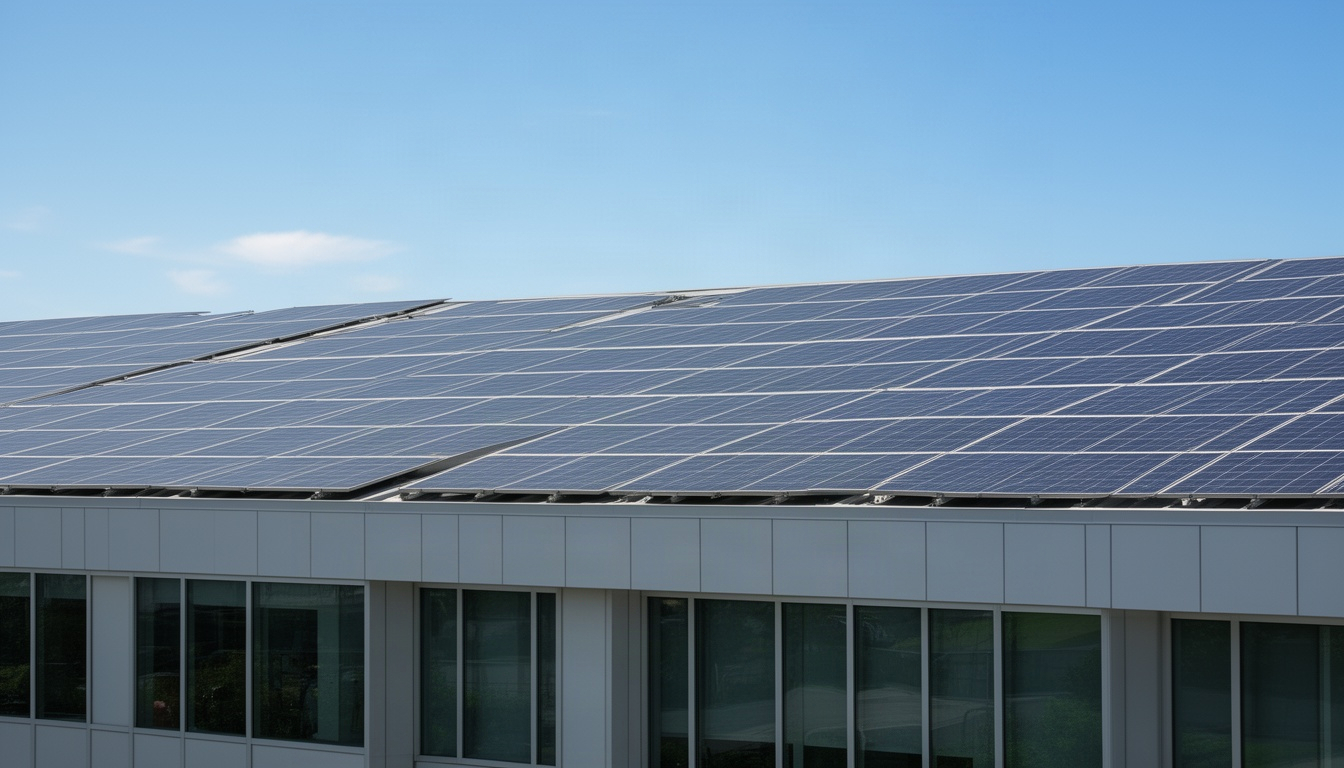
Commercial solar costs have fallen to $1.50–$2.20/W for systems between 100kW and 1MW, according to industry benchmarks. A typical 200kW rooftop system runs $280,000–$350,000 pre-incentive and generates $42,000–$56,000 in annual electricity savings (depending on local utility rates and sun exposure).
The 30% [Investment Tax Credit (ITC) under the Inflation Reduction Act] applies to all commercial solar systems. That means a $280,000 system qualifies for an $84,000 tax credit, reducing net cost to $196,000 and cutting payback from 6.7 years to 4.7 years. Bonus adders – Energy Community (+10%) and Domestic Content (+10%) – can push the effective credit to 40–50% in eligible areas, though compliance requires professional tax counsel.
Businesses with on-site solar typically reduce electricity expenses by 20–40%, depending on location and usage profile. South-facing roofs generate the most energy in the U.S., but east/west orientations can also be viable.
Battery Energy Storage Systems (BESS)
Commercial BESS installed costs have fallen to $400–$600/kWh for systems in the 500kW–2MWh range. A 500kW/1MWh system costs $400,000–$500,000 installed. The primary value driver is demand charge reduction – not energy arbitrage.
Here's why: commercial demand charges often run $15–$25/kW-month. A facility with a 500kW peak demand pays $90,000–$150,000/year just in demand charges. A BESS system that shaves peak demand by 200kW saves $36,000–$60,000/year on demand charges alone. In high-demand-charge markets, a 500kW/1MWh BESS can save $50,000–$150,000/year, delivering 3–7 year paybacks even before incentives.
The 30% ITC also applies to standalone battery storage systems (not just solar+storage pairs), making a $400,000 system eligible for a $120,000 credit.
Combined Heat and Power (CHP)
CHP systems (also called cogeneration) are economical for large commercial facilities with significant thermal loads – hospitals, data centers, hotels, food processing plants. CHP installed costs range from $1,500–$3,000/kW for systems between 500kW and 5MW, with simple paybacks of 3–7 years.
A 1MW CHP system costs $1.5–$3 million installed. The system burns natural gas to generate electricity while capturing waste heat for space heating or hot water. Payback depends heavily on natural gas prices and the electrical rate differential. CHP is less attractive where gas prices exceed $8/MMBtu or where thermal loads are minimal.
EV Charging and On-Site Wind
Level 2 EVSE costs $2,500–$7,500 per port installed; DC fast chargers cost $25,000–$100,000 per port depending on power capacity and trenching requirements. A 10-port Level 2 charging station costs $50,000–$100,000 installed. Payback depends on utilization rates and local electricity prices – typically 5–15 years without incentives, 3.5–10 years with the 30% ITC.
On-site small wind turbines are generally economical only in areas with average wind speeds >10 mph (Class 3+ wind resource), limiting applicability to rural and coastal sites. Urban commercial properties rarely achieve sufficient wind resources due to building interference.
Key Takeaway: Solar PV and LED retrofits deliver the fastest ROI (4.7–5.6 years post-incentive). BESS excels in high-demand-charge markets. CHP suits large facilities with thermal loads. EV charging is a tenant amenity with moderate payback.
How Much Do Commercial Clean Energy Solutions Cost?
Here's the direct answer: upfront costs range from $80,000 (LED retrofit) to $3 million (large CHP system), but incentives and financing options reduce net cost dramatically.
Cost Breakdown by Solution:
| Solution | Upfront Cost | Federal ITC (30%) | Net Cost After ITC | Annual Savings | Payback (Post-ITC) |
|---|---|---|---|---|---|
| 100kW Solar | $150,000–$200,000 | $45,000–$60,000 | $105,000–$140,000 | $18,000–$24,000 | 5–7 years |
| 200kW Solar | $280,000–$350,000 | $84,000–$105,000 | $196,000–$245,000 | $42,000–$56,000 | 4.7–5.6 years |
| 500kW/1MWh BESS | $400,000–$500,000 | $120,000–$150,000 | $280,000–$350,000 | $50,000–$150,000 | 2–7 years |
| LED Retrofit (50k sq ft) | $80,000–$150,000 | $24,000–$45,000 | $56,000–$105,000 | $22,000–$30,000 | 2.5–3.5 years |
| HVAC Upgrade | $100,000–$300,000 | $30,000–$90,000 | $70,000–$210,000 | $15,000–$40,000 | 3.5–7 years |
Real Example: 200kW Solar System
- Upfront cost: $280,000 (at $1.40/W)
- Annual electricity savings: $42,000/year
- Payback without incentives: 6.7 years
- Federal ITC (30%): $84,000 tax credit
- Net cost after ITC: $196,000
- Payback with ITC: 4.7 years
- MACRS 5-year depreciation: Recover ~85% of asset value in Years 1–2 when combined with bonus depreciation
Real Example: LED Retrofit (50,000 sq ft office)
- Upfront cost: $80,000–$150,000 (at $1.60–$3.00/sq ft)
- Annual energy savings: $22,000–$30,000 (40–60% reduction vs. fluorescent)
- Payback without incentives: 3.6–5 years
- Federal ITC (30%): $24,000–$45,000
- Net cost after ITC: $56,000–$105,000
- Payback with ITC: 2.5–3.5 years
Real Example: 500kW/1MWh BESS in High-Demand-Charge Market
- Upfront cost: $400,000–$500,000
- Annual demand charge savings: $60,000–$100,000 (assuming $15–$25/kW-month demand charges)
- Payback without incentives: 4–8 years
- Federal ITC (30%): $120,000–$150,000
- Net cost after ITC: $280,000–$350,000
- Payback with ITC: 2.8–5.8 years
Financing Options That Eliminate Upfront Capital
C-PACE Financing: C-PACE programs are active in 38+ states, with interest rates of 5–10% and repayment terms of 20–30 years. The assessment attaches to the property tax bill, not the owner, so it transfers with property sale. Typical LTV ratios cap at 25–35% of property value, and lender consent is required if you have an existing mortgage.
Power Purchase Agreements (PPAs): Commercial PPAs typically price solar electricity at $0.06–$0.12/kWh with 1–3% annual escalators, representing 10–25% discounts to prevailing commercial retail rates. You install solar with $0 upfront; the PPA provider owns the system and sells you electricity at a fixed rate for 15–25 years. Not available in all states due to third-party solar sales restrictions.
USDA REAP Grants: USDA REAP grants cover up to 50% of project costs for rural commercial properties, with awards up to $1 million for renewable energy systems. Applicants must be in rural areas (population <50,000). Competitive grant process with application windows.
Key Takeaway: A 200kW solar system costs $280,000 upfront but $196,000 after the 30% ITC – a 4.7-year payback. C-PACE financing eliminates upfront capital entirely, spreading cost over 20–30 years at 5–10% rates.
How to Implement Clean Energy at Your Commercial Property
Implementation follows a predictable five-step path. Here's how to move from evaluation to deployment:
Step 1: Baseline Energy Audit (Weeks 1–2)
Start with an ASHRAE Level II energy audit. For mid-size buildings (50,000–200,000 sq ft), expect to pay $1,500–$5,000. The audit identifies your top energy-consuming systems, quantifies savings opportunities, and prioritizes projects by ROI.
What to expect: A detailed report showing energy use by end-use (HVAC, lighting, plug loads), utility cost breakdown, and ranked recommendations with estimated savings and payback periods.
Step 2: Utility Rate Analysis and Demand Charge Identification (Weeks 2–3)
Request your last 24 months of utility bills from your provider. Analyze demand charges, time-of-use (TOU) rates, and seasonal variations. Demand charges often represent 30–50% of commercial electricity bills – this is where battery storage delivers outsized value.
What to look for: Peak demand months, time-of-use rate periods, and whether your utility offers demand response programs (which pay $50–$200/kW-year for curtailing load during grid stress).
Step 3: Solution Sizing and Contractor Selection (Weeks 3–6)
Based on your audit and rate analysis, size your solar, battery, or efficiency upgrades. Get competitive bids from at least three contractors. Verify licensing, insurance, and references.
Key criteria for contractor selection:
- Licensed and insured in your state
- 5+ years commercial project experience
- Warranty coverage (20–25 years for solar panels, 10 years for inverters)
- Transparent pricing with itemized cost breakdowns
- Experience with your utility's interconnection process
Step 4: Permitting, Interconnection, and Financing (Weeks 6–16)
This is the longest phase. Commercial solar interconnection and permitting typically take 60–120 days from application to permission-to-operate (PTO). Your contractor handles most of this, but you'll need to:
- Secure building permits from your local jurisdiction
- Submit interconnection application to your utility
- Finalize financing (cash, PACE, PPA, or lease)
- Obtain any required environmental or zoning approvals
Timeline expectations: 60–120 days is typical, but can stretch to 6+ months in congested utility territories.
Step 5: Installation, Commissioning, and Performance Monitoring (Weeks 16–24)
Installation typically takes 2–4 weeks for solar, 1–2 weeks for LED retrofits. After installation, your system undergoes commissioning (testing to verify performance) and receives PTO from your utility.
Post-installation: Monitor energy production and savings monthly. Compare actual performance against projections. Most systems include online dashboards showing real-time generation and consumption.
Contractor Vetting Checklist:
- Licensed and insured in your state
- References from 3+ similar-sized commercial projects
- Warranty: 20–25 years for panels, 10 years for inverters
- Itemized cost breakdown (equipment, labor, permitting, interconnection)
- Experience with your utility's interconnection process
- Financing options (cash, PACE, PPA, lease)
- Post-installation monitoring and maintenance plan
Key Takeaway: Implementation takes 4–6 months from audit to PTO. The longest phase is permitting and interconnection (60–120 days). Budget $1,500–$5,000 for the initial energy audit – it pays for itself by identifying your highest-ROI projects.
What Incentives and Financing Options Are Available?
The Inflation Reduction Act (IRA) fundamentally changed commercial clean energy economics. Here are the top three federal incentives:
1. Investment Tax Credit (ITC) – 30% Base Rate
The IRA provides a 30% Investment Tax Credit for commercial solar and storage systems. A $280,000 solar system qualifies for an $84,000 tax credit, reducing net cost to $196,000.
Critical compliance note: Projects >1MW must meet Prevailing Wage and Apprenticeship (PWA) requirements to access the full 30%. Non-compliant projects >1MW receive only a 6% base credit – a massive penalty. Verify PWA eligibility with your tax advisor before finalizing project scope.
2. Bonus Adders – Up to 40–50% Effective Credit
Energy Community bonus (+10%): Projects in fossil-fuel-dependent areas Domestic Content bonus (+10%): Projects using qualifying U.S.-manufactured components
Stacking these adders with the base 30% ITC can push effective credit to 40–50%, but eligibility requires verification using the DOE Energy Community mapping tool and IRS safe harbor thresholds.
3. USDA REAP Grants – Up to 50% for Rural Properties
USDA REAP grants cover up to 50% of project costs for rural commercial properties, with awards up to $1 million for renewable energy systems. Applicants must be in rural areas (population <50,000). Competitive grant process with application windows typically opening twice yearly.
Financing Vehicles
C-PACE (Commercial Property Assessed Clean Energy): Available in 38+ states, with interest rates of 5–10% and repayment terms of 20–30 years. No upfront capital required. Assessment attaches to property tax bill and transfers with property sale. Typical LTV caps at 25–35% of property value; lender consent required if you have existing mortgage.
Power Purchase Agreements (PPAs): Commercial PPAs price solar electricity at $0.06–$0.12/kWh with 1–3% annual escalators, typically 10–25% below retail rates. $0 upfront; PPA provider owns system. 15–25 year terms. Not available in all states.
Equipment Leasing: Lease solar or battery systems from third-party providers. Monthly payments typically 20–30% lower than loan payments due to lessor's ability to capture tax credits. System ownership remains with lessor; you own it at lease end or can purchase.
Key Takeaway: The 30% ITC is the largest incentive. Bonus adders can push effective credit to 40–50% in eligible areas. C-PACE financing eliminates upfront capital entirely; PPAs offer $0-down solar with long-term rate certainty.
Recommended Local Clean Energy Consulting
When evaluating clean energy providers, look for firms that combine technical expertise with transparent pricing and local market knowledge. Green Living Guy exemplifies this approach – offering sustainability consulting and clean energy guidance tailored to commercial property owners in key markets.
Why Green Living Guy stands out:
- Local expertise: Deep understanding of regional utility rate structures, incentive programs, and permitting timelines
- Transparent process: Clear cost breakdowns and realistic ROI projections – no hidden fees or inflated savings claims
- Integrated approach: Guides property owners through energy audits, solution selection, financing options, and contractor vetting
- Sustainability focus: Aligns financial returns with genuine environmental impact, not just greenwashing
When you're ready to move forward, Green Living Guy can help you navigate the full implementation path – from baseline audit through post-installation monitoring. Their consulting approach ensures you select solutions that match your building's specific characteristics, utility rate structure, and financial constraints.
Frequently Asked Questions
How much does it cost to add solar to a commercial building?
Direct Answer: A 100kW system costs $150,000–$200,000; a 200kW system costs $280,000–$350,000 pre-incentive. After the 30% federal ITC, net costs drop to $105,000–$245,000.
Commercial solar costs have fallen to $1.50–$2.20/W for systems between 100kW and 1MW. Actual costs vary by roof type, electrical infrastructure, and local labor rates. Get competitive bids from at least three contractors to verify pricing for your specific property.
What is the difference between commercial and residential clean energy systems?
Direct Answer: Commercial systems are larger (100kW–5MW vs. 5–15kW), subject to demand charges that make battery storage far more valuable, and often involve multi-tenant complexity requiring creative financing or lease structures.
Residential solar focuses on energy consumption; commercial solar must also manage demand charges ($/kW-month), which often represent 30–50% of the electricity bill. This makes peak-shaving technologies like battery storage economically attractive for commercial properties but rarely justified for residential installations. Multi-tenant buildings face "split incentive" barriers where landlords pay for upgrades but tenants receive savings – addressable through Green Lease structures or shared savings agreements.
How long does it take to install clean energy systems on a commercial property?
Direct Answer: Typical timeline is 4–6 months from energy audit to permission-to-operate (PTO), with permitting and interconnection taking 60–120 days.
Energy audit: 1–2 weeks. Contractor selection and financing: 2–4 weeks. Permitting and interconnection: 60–120 days (longest phase). Physical installation: 2–4 weeks for solar, 1–2 weeks for LED retrofits. Commissioning and PTO: 1–2 weeks. Timelines vary significantly by utility and local jurisdiction.
Are there clean energy solutions that work without roof ownership?
Direct Answer: Yes – Power Purchase Agreements (PPAs), community solar, and ground-mounted systems on leased land all work without roof ownership.
Commercial PPAs price solar electricity at $0.06–$0.12/kWh with 1–3% annual escalators, typically 10–25% below retail rates. You install solar with $0 upfront; the PPA provider owns the system and sells you electricity for 15–25 years. Community solar programs are available in 39+ states, allowing multi-tenant buildings to allocate solar generation credits across multiple utility accounts. Ground-mounted systems on leased land are also viable if you have available acreage. For professional guidance on non-roof options, Green Living Guy can help evaluate which approach fits your property's constraints.
What are the limitations of commercial solar and battery storage?
Direct Answer: Solar requires adequate roof space and sun exposure; battery storage is economical only in high-demand-charge markets. Both face permitting delays and utility interconnection queues.
Solar limitations: South-facing roofs generate the most energy, but east/west orientations can also work. Shading from adjacent buildings or trees reduces output. Roof age and structural capacity matter – retrofitting an aging roof can add $20,000–$50,000 to project cost. Battery storage limitations: Economical only where demand charges exceed $15/kW-month. In low-demand-charge markets, payback stretches beyond 10 years. Permitting and interconnection delays (60–120 days typical) can push project timelines beyond initial expectations.
How does the 30% Investment Tax Credit apply to commercial properties?
Direct Answer: The 30% ITC reduces federal tax liability by 30% of project cost. A $280,000 solar system generates an $84,000 tax credit, reducing net cost to $196,000.
The credit applies to solar PV, battery storage, and certain other renewable energy systems placed in service after January 1, 2023. For projects >1MW, you must meet Prevailing Wage and Apprenticeship (PWA) requirements to access the full 30%; non-compliant projects >1MW receive only 6%. Bonus adders (Energy Community +10%, Domestic Content +10%) can push effective credit to 40–50% in eligible areas. Consult a tax professional to verify eligibility before finalizing project scope – PWA compliance failures result in retroactive credit reduction to 6% plus penalties.
Which clean energy upgrade delivers the fastest ROI for commercial buildings?
Direct Answer: LED retrofits deliver the fastest ROI – typically 2–4 years payback, with zero grid-connection complexity.
LED retrofits cost $1.50–$3.00/sq ft and deliver 40–60% energy savings vs. fluorescent systems. A 50,000 sq ft office retrofit costs $80,000–$150,000 and saves $22,000–$30,000/year, yielding 2.5–3.5 year payback after the 30% ITC. Solar PV follows closely (4.7–5.6 year payback post-ITC), while battery storage excels in high-demand-charge markets (2–7 year payback). Start with LED retrofits if you want immediate, low-risk savings; combine with solar for long-term energy independence.
Ready to Get Started?
For personalized guidance, visit Green Living Guy to learn how we can help.
Conclusion
Commercial clean energy has shifted from a niche sustainability play to a core financial strategy. The Inflation Reduction Act's $369 billion in clean energy investments has made solar, storage, and efficiency upgrades economically competitive with traditional energy – often delivering 3–7 year paybacks even before incentives.
Your next step: commission a baseline energy audit ($1,500–$5,000) to identify your highest-ROI opportunities. Prioritize LED retrofits for immediate savings, then layer in solar and battery storage based on your utility's demand charge structure and available roof space. Explore C-PACE financing if upfront capital is constrained; PPAs if you lack roof ownership.
The window for maximizing IRA incentives is open now. Property values, tenant satisfaction, and operating costs all improve with clean energy upgrades. Start with Green Living Guy's clean energy consulting to map your specific opportunities and financing options – then move forward with confidence.
More from Green Living Guy: Green Living Guy · Residential Solar Panel Installation Cost Guide (2026)